12th Annual Buddy Walk & Inaugural Down Syndrome

Cycling Century Ride - Scheduled for 2012

Buddy Walk Logo

CLICK HERE for Buddy Walk (ONLY)
Online Registration Form

Dear Buddy Walk Teams, Walkers, Supporters and New Cyclist,

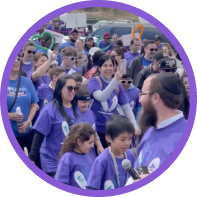
YES, the 2012 Buddy Walk has been scheduled.  After many years of wanting to, DSOSN has made the decision to move the Buddy Walk to the spring.

The reason for this move is that we are so "fall' heavy with events that we believe moving the Buddy Walk to the spring will give it more exposure, increase the size of the event and do it more justice all the way around in promoting inclusion and acceptance of individuals with Down syndrome as well as eventually increase fundraising.

And we have some other very exciting news - we are adding a bike ride cycling component to the event.  This year it is called the Inaugural Down Syndrome Cycling Century Ride.  DSOSN felt the need to have a charity cycling event to reach out to other participants in helping those we serve.  We are striving to make the DSOSN Century an event with involvement from the entire Las Vegas cycling community.

We are very proud to annouce The South Point Hotel & Casino as our Event Venue Sponsor.   Date and Venue details are:

South Point Logo

12th Annual Buddy Walk &

Inaugural Down Syndrome Cycling Century Ride

Saturday - March 31, 2012

The South Point Hotel & Casino

 (North-East Parking Lot)

9777 Las Vegas Blvd South, Las Vegas, NV  89183

We understand that fundraising might be a challenge this year since we just completed the 2011 Buddy Walk less than six months ago.  But we just know that everyone is going to do the best they can reaching out to their past donors as well as seeking out new donors.  On that note, we ask all past Buddy Walk Teams, Team Captains, Walkers and Supporters to join us this year and be positive in knowing that it will be very successful.

Below are details pertaining to the 2012 Buddy Walk and also new details for the cyclist.  Please refer to your area of participation and interest.>

2012 Buddy Walk Details:

Everything remains the same as far as signing up as a team, team captain, walker, sponsor and for other supporters.  You can register as a team or walker by filling out the 2012 Buddy Walk/Cyle Brochure (link attached below).  Or you can download this brochure from the DSOSN website at www.dsosn.org.  Also, all the below Buddy Walk forms you can download from here or download from our website by the end of this week.  And by the end of this week, you can also register directly through the website.  We appreciate your patience.

2012 Buddy Walk/Cycle Brochure

2012 Buddy Walk Registration Form Only

2012 Buddy Walk Team Captain Commitment Form

2012 Buddy Walk At A Glance

2012 Buddy Walk Fact Sheet

2012 Buddy Walk Team Captain Kit

2012 Buddy Walk Walker Kit

2012 Buddy Walk Volunteer Waiver - Adult

2012 Buddy Walk Volunteer Waiver - Under 18

2012 Buddy Walk Donation Request Letter

2012 Buddy Walk/Cycle Sponsorship Opportunities

2012 Buddy Walk/Cycle Sponsorship Response Form

2012 Buddy Walk/Cycle Raffle & Other Interest Response Form

2012 Buddy Walk/Cycle Dangler

Other way to help spread the word and fundraise:

 AND DON'T FORGET ABOUT FIRSTGIVING:

Firstgiving Logo

The 2012 Buddy Walk Firstgiving Event Page is up and ready to go.  Last year Firstgiving Buddy Walk fundraisers raised over $24,000 online!  That is the best it has every done.  This is a great way to raise extra money towards your team or walker today.

For 2012, just go to the following link to sign up for your very own Free Firstgiving Fundraising Page today:

www.firstgiving.com/dsosn/buddywalk2012


Buddy Walk Day of Event Schedule on March 31, 2012

1:00 - 3:00 pm - Registration & Check-In

Ongoing Fun, Food, Games and Entertainment

3:00 - 3:20 pm - Welcome, Announcements & Proclamations

3:30 - 3:30 pm - Exercise Warm-Up

3:30 - 4:00 pm - Let the Walk Begin! - around the South Point Property

4:00 - 5:00 pm - Raffle

Other Information:

This year the Buddy Walk will be held in the North-East Parking Lot of the South Point.  There will be tents, tables and chairs as well as an artificial grass area for blankets and games for the children.  Please feel free to bring your blanket or even a small tent - but know the tent will be placed on the parking lot cement and cannot be staked into the ground as there will be no real grassy areas.  Food will be available (donations accepted).  you can also bring your own picnic lunch!  Strollers and wheelchairs are welcome.  For this particular venue, we request that you do not bring pets.

THANK YOU EVERYONE

FOR EMBRACING THIS EVENT

 AND

 BEING A BUDDY -

 WHICH MAKES YOU A STAR!

Cycling Picture

Inaugural Down Syndrome

Cycling Century Ride

DETAILS


DSOSN is proud and thrilled to be hosting its very first cycling century ride to benefit those affected by Down syndrome in our community.  We know that there are lots of cyclist out there who love to ride and we would love to have you join us and embrace our mission in providing programs and services to local individuals with Down syndrome. 100% of net proceeds raised from this event and Buddy Walk stay locally here in Southern Nevada.

Cyclist can register for the ride by visiting Active.com or through the DSOSN website at www.dsosn.org.   Or you can download a registration form below.

Please see the 3 page Cyclist Fact Sheet for complete ride and registration details.

Cycling Event Times:

100 Mile Start:  6:30 am

50 Mile Start:    7:30 am

15 Mile Start:    9:00 am

Rest Stop 1 Closes at 11:00 am

Rest Stop 2 Closes at 5:00 pm

Rest Stop 3 Closes at 3:00 pm

Course Closed at 5:00 pm

All Riders Swept from Course

Helmets MUST be Worn at All Times on the Course

Packet Pick-Up will be available on Friday - March 16th at the South Point Event Site (North-East Parking Lot) from 12 noon - 8 pm.

Register early:  T-shirts are not guaranteed after 3/21/2012

2012 Cyclist Registration Form 

2012 Down Syndrome Cycling Century Ride Fact Sheet - 3 pages

Also, if you know of a potential sponsor, raffle or other donor, please feel free to download the forms above listed under Buddy Walk details.  These forms apply for both the Buddy Walk and Cycle Event.

We also encourage cyclist to fundraise and use the forms above as they apply.  And there is a Firstgiving Cycle Event page set up strictly for cyclist.  Click on the link below and get started creating your very own fundraising page.  Send it out to all our email business, friends and family contacts locally and around the country.  You'll be surprised how much you can raise!

www.firstgiving.com/dsosn/inaugural-down-syndrome-century-ride

We thank all returning Buddy Walk Teams, Walkers, Sponsors and Supporters and welcome our new Cycling Partners to this fabulous event.  We can't wait to see everybody there on Saturday - March 31, 2012!

Contact Details:

Down Syndrome Organization of Southern Nevada (DSOSN)

5300 Vegas Drive, Las Vegas, NV  89108

PH:  702-648-1990   FAX:  702-648-2020

Website:  www.dsosn.org

Contact Person:  Deann Cline - Director of Fund Development

Email:  dcline@dsosn.org

  • Mission
  • History
  • About Down Syndrome
  • New Parents
  • Early Intervention
  • Education
  • A Physician’s Guide
  • Members
  • DSOSN News Letter
  • Up Coming Events
  • Sponsors
  • Calendar

Our Mission

Our Mission The mission of the Down Syndrome Organization of Southern Nevada is to enlighten the public by promoting a positive understanding of Down syndrome in the community and be a source of support, information and education for families and individuals affected by Down syndrome. The vision of the Down Syndrome Organization of Southern Nevada is for individuals with Down Syndrome to be accepted in the community and respected for their abilities and contributions.

-----------------

DSOSN Overview, Programs & Services,
Mission & History 

The Down Syndrome Organization of Southern Nevada (DSOSN) became incorporated as a 501(c)(3) non-profit organization  in 1987 and is comprised of families with a child who has Down syndrome, and others who are interested in the effects of Down syndrome on those families.  (FD TAX ID # 94-3040560)  We are affiliated with the National Down Syndrome Congress, The National Down Syndrome Society and the National Association for Down Syndrome.

The DSOSN offers support, direction, services and resources to hundreds of Southern Nevada families affected by this occurrence. Early intervention and support play a direct role in the successful integration of these valuable citizens into the family and the community. Individuals with Down syndrome can become active, participating members of the community, and can enjoy an active and fulfilling life with the assistance of the DSOSN. 

The programs and services we provide include speech, music, yoga, physical and Spirit horse therapies as well as life skill and educational seminars, support groups, Hispanic outreach, our Lending Resource Library, member socials and the Teen and Young Adult Club. The DSOSN serves those in the greater Las Vegas, Nevada area, including the cities of Henderson, North Las Vegas, Boulder City, and other areas of Clark County as well as Pahrump.

The DSOSN is funded primarily through the generosity of our supporters, which include members of the medical community, the business community, corporations, foundation grants, individual supporters, and the families of the special, vulnerable people we love so much. We do not receive any state or federal funding.

The DSOSN employs a Director of Fund Development and a Director of Programs. The organization is governed by a 9-person board of directors. We publish a periodic newsletter that deals with many of the issues surrounding Down syndrome, and features news and announcements about events in Southern Nevada that impact the lives of individuals and families in Southern Nevada affected by Down syndrome.


About Down Syndrome

Image2 Down syndrome is a genetic condition that occurs in one in every 691 births. It is the most frequently occurring chromosomal condition and is found in people of all races and economic levels.  More than 400,000 people in the United States have Down syndrome. 
 
A few of the common physical traits of Down syndrome are low muscle tone, small stature, an upward slant to the eyes, and a single deep crease across the center of the palm. Every person with Down syndrome is a unique individual and may possess these characteristics to different degrees or not at all.
 
People with Down syndrome have an increased risk for certain medical conditions such as congenital heart defects, respiratory and hearing problems, Alzheimer's disease, childhood leukemia, and thyroid conditions.  However, many of these conditions are now treatable, so most people with Down syndrome lead healthy lives.  Life expectancy for people with Down syndrome has increased dramatically in recent decades - from 25 in 1983 to 60 today.
 
People with Down syndrome experience cognitive delays, but the effect is usually mild to moderate and is not indicative of the many strengths and talents that each individual possesses.  Children with Down syndrome learn to sit, walk, talk, play, and do most other activities; only somewhat later than their peers without Down syndrome.
 
Quality educational programs, a stimulating home environment, good health care, and positive support from family, friends and the community enable people with Down syndrome to develop their full potential and lead fulfilling lives.  People with Down syndrome attend school and work, and participate in decisions that concern them, and contribute to society in many wonderful ways.

New & Expectant Parents

https://lh3.googleusercontent.com/-ltjDeTX2EA8/Td32DChdDZI/AAAAAAAAA8A/nW7LlosFb0k/s320/9.jpg
If you have arrived here, there is a good chance you have received news you did not expect. As an expectant or new parent you have been told your child has Down syndrome


If your child has arrived, please accept the sincere congratulations of our entire community!

Whether you are celebrating the birth of your child or anticipating its arrival, here you will find the basic information you need  — to manage your pregnancy, plan for the delivery and to get started on the rewarding processes of having a child with Down syndrome in your life.

The most important thing to keep in mind is that this diagnosis is not as life changing as the fact that you have a new baby. And in most ways, your baby will be just like other infants. Every baby needs to be fed, held and most of all, loved.
There will be challenges in raising your child, but there will also be many, many joys. It's normal to be nervous about what lies ahead, but remember that Down syndrome is a condition your baby has, it is not who your baby is. Now is the time to begin learning all you can about Down syndrome and this website is a great place to start.
Want to start now?

If you would like to speak with a parent from DSOSN's New Member Committee, please call our office at 702.648.1990. You will be connected with a parent in your area who can offer support, information and friendship to you as you begin your life with your new baby.

If you are a father of a child with Down Syndrome and you want to meet other fathers with the same concerns and needs as you, contact David Frydman at dfrydman@dsosn.org to join the local D.A.D.S. Chapter (Dads Appreciating Down Syndrome)


If you would like to speak to an information specialist at the National Down Syndrome Society (Monday-Friday from 9am to 5pm EST) call 1-800-221-4602.

Click Here to watch the National Down Syndrome Society's new parent video, A Promising Future Together: A Guide for New Parents of Children with Down Syndrome. This video features families discussing different stages in their children's lives, as well as developmental pediatricians and other professionals giving information about medical, social and educational issues for families of children with Down syndrome. The video covers early intervention, local and national resources and health care screenings that can help their children achieve their full potential.


Click Here to download a PDF version of A Promising Future Together: A Guide for New Parents of Children with Down Syndrome, by the National Down Syndrome Society, or call 1-800-221-4602 to order a complimentary copy in English or Spanish.

Click Here to visit Brighter Tomorrows, a web-based resource on receiving a diagnosis of Down syndrome prenatally or at birth. Brighter Tomorrows provides answers to questions that families and prospective parents may have at this critical moment in their lives. In both English and Spanish. 


NEW PARENT PACKAGE:
Down Syndrome: A New Parents’ Guide
Facts about Down Syndrome
Baby is a Baby First
Language Guidelines
Bibiliography 2008
Your Baby and Down Syndrome
New Parent / Early Intervention Resources (PDF)
Advice For New Parents (DOC)
Healthcare Guidelines (PDF)
Welcome to Holland

EXPECTANT PARENT INFORMATION:
Down Syndrome: An Expectant Parents’ Guide
Expectant Parents Introduction
Light at The End of The Tunnel (PDF)

Early Intervention

Birth to 3: Early Intervention

The first years of life are a critical time in a child’s development. All young children go through the most rapid and developmentally significant changes during this time. During these early years, they achieve the basic physical, cognitive, language, social and self-help skills that lay the foundation for future progress, and these abilities are attained according to predictable developmental patterns. Children with Down syndrome typically face delays in certain areas of development, so early intervention is highly recommended. It can begin anytime after birth, but the sooner it starts, the better.
  
This section provides details on the various kinds of early intervention available, and how to access services.
  
What is early intervention?
  
Early intervention is a systematic program of therapy, exercises and activities designed to address developmental delays that may be experienced by children with Down syndrome or other disabilities. These services are mandated by a federal law called the Individuals with Disabilities Education Act (IDEA). The law requires that states provide early intervention services for all children who qualify, with the goal of enhancing the development of infants and toddlers and helping families understand and meet the needs of their children. The most common early intervention services for babies with Down syndrome are physical therapy, speech and language therapy, and occupational therapy. 
  
When should early intervention start?
  
Early Intervention should begin any time shortly after birth, and usually continue until the child reaches age three. An amendment to IDEA in 2004 allows States to have early intervention programs that may continue until the child enters, or is eligible to enter, kindergarten. The sooner early intervention begins, the better, however, it's never too late to start.
  
How can early intervention benefit a baby?
  
Development is a continuous process that begins at conception and proceeds stage by stage in an orderly sequence. There are specific milestones in each of the four areas of development (gross and fine motor abilities, language skills, social development and self-help skills) that serve as prerequisites for the stages that follow. Most children are expected to achieve each milestone at a designated time, also referred to as a “key age,” which can be calculated in terms of weeks, months or years. Because of specific challenges associated with Down syndrome, babies will likely experience delays in certain areas of development. However, they will achieve each of the same milestones as other children, just on their own timetable. In monitoring the development of a child with Down syndrome, it is more useful to look at the sequence of milestones achieved, rather than the age at which the milestone is reached.
  
Each type of early intervention addresses specific aspects of a baby’s development.
  
Physical therapy focuses on motor development. For example, during the first three to four months of
life, an infant is expected to gain head control and the ability to pull to a sitting positions (with help) with no head lags and enough strength in the upper torso to maintain an erect posture. Appropriate physical therapy may assist a baby with Down syndrome, who may have low muscle tone, in achieving this milestone.
  
Before birth and in the first months of life, physical development remains the underlying foundation for all future progress. Babies learn through interaction with their environment. In order to do so, an infant must have the ability to move freely and purposefully. The ability to explore one's surroundings, the ability to reach and grasp toys, to turn one's head in order to follow a moving object with one's eyes, the ability to roll over, to crawl in pursuit of a desired objective, all of these behaviors are dependent upon gross as well as fine motor development. These physical, interactive activities foster understanding and mastery of the environment, stimulating cognitive, language and social development.
  
Another long term benefit of physical therapy is that it helps prevent compensatory movement patterns that individuals with Down syndrome are prone to developing. This can lead to orthopedic and functional problems if not corrected.
  
Speech and language therapy is a critical component of early intervention. Even though babies with Down syndrome may not say first words until 2 or 3 years of age, there are many pre-speech and pre-language skills that must be acquired first. These include the ability to imitate and echo sounds; turn taking skills (learned through games like “peek-a-boo”); visual skills (looking at the speaker and objects); auditory skills (listening to music and speech for lengthening periods of time, or listening to speech sounds); tactile skills (learning about touch, exploring objects in the mouth); oral motor skills (using the tongue, moving the lips); and cognitive skills (understanding object permanence, and cause and effect relationships).
  
A speech and language therapist can help with these and other skills, including breastfeeding. Because breastfeeding employs the same anatomical structures used for speech, it can help strengthen a baby’s jaw and facial muscles and lay the foundation for future communication skills.
  
Occupational therapy helps children develop and master skills for independence. Occupational therapy can help with abilities such as opening and closing things, picking up and releasing toys of various sizes
and shapes, stacking and building, manipulating knobs and buttons, experimenting with crayons etc. Therapists also help children learn to feed and dress themselves, and teach skills for playing and interacting with other children.
  
Early intervention can also prevent a child with Down syndrome from reaching a plateau at some point in development. Thus, the goal of early intervention programs is to enhance and accelerate development by building on a child's strengths and by strengthening those areas that are weaker, in all areas of development.
  
How can parents benefit from early intervention programs?
  
Programs of early intervention have a great deal to offer to parents in terms of support, encouragement and information. The programs teach parents how to interact with their infant and toddler, how to meet their child's specific needs and how to enhance development.
  
How do I sign up for early intervention services?
  
Each state has its own set of laws governing early intervention services  (CLICK HERE FOR NEVADA EARLY INTERVENTION).  Parents can get a referral from the baby’s doctor, Once a referral has been made, the program staff must schedule and complete an initial evaluation within a specified time. Once the assessment is done, a caseworker is assigned to coordinate the various services for which the baby and family qualifies. Early intervention services are individualized to mete the specific needs of each individual baby. The caseworker, therapists and family will determine the areas of focus and set goals based on the developmental milestones. These will be recorded in a document called the Individualized Family Service Plan or IFSP.
  
Who pays for early intervention?
  
The evaluation to determine whether your child is eligible for early intervention is free of charge if performed by a state authorized entity. No child deemed eligible can be denied services based on ability to pay, but insurance companies may be billed and/or a sliding scale payment may be required, depending on what state you reside in. Check with your state's early intervention center for information about authorized service providers and financial obligations. Frequently, there is little or no cost to parents for these services.
  
What happens after age 3?
  
IDEA, which regulates early intervention, also mandates that local school districts provide a free, appropriate, public education for preschool-age children with disabilities starting at the age of 3, unless that would be inconsistent with State law or practice, or the order of any court, respecting the provision of public education to children between the ages of 3 and 5. 

Education

The following Speech and Language Resource Guides for individuals with Down syndrome have been generously provided to the NDSC and its members by Dr. Libby Kumin and Loyola College of Maryland.

Delivering a Diagnosis
Expert advice in assisting physicians facing the challenge of informing parents that a child has or may have Down Syndrome.
http://www.ndsccenter.org/physiciansguide/

While there is no “cure” for Down syndrome, experts in pediatric medicine consider it a treatable condition. Indeed, the single most dramatic change effected by our community has been the astounding improvement of the health of people with Down syndrome. Through the caring innovation of medical professionals, the typical lifespan of an individual with Down syndrome now approaches the average for all people. Equally important, advancements in cardiology, nutrition, the behavioral sciences and so much more have opened a high quality of life for most if not all people with Down syndrome.
You will find the basics of proper health care for people with Down syndrome by clicking on the titles bellow. If you have additional questions or concerns, we encourage to search this site for additional articles and information or to contact the NDSC Center.

Board Members-Who We Are

  • Director of Fund Development
    Deann Cline
    dcline@dsosn.org

  • Chair:   David Frydman 

  • Vice-Chair:   Sandy Windom

  • Secretary:   Taiya Thompson

  • Treasurer:   Robert Treants

  • General Board of Directors

  • Jeffrey Fine

  • Lori Hutchison

  • Sandy Windom

  • Evelyn Yusico-Housewright


UP COMING EVENTS

2012 Buddy Walk & Inaugural Down Syndrome Cycling Century Ride
.

Saturday – March 31, 2012

South Point Hotel & Casino
9777 Las Vegas Blvd So, Las Vegas, NV 89183
(North-East Parking Lot)


Click Here
2012 Buddy Walk Brochure & Registration Form

DIMES FOR DOWN SYNDROME 
 
The 2011- 2012 Dimes for Down Syndrome Campaign will begin  in September right after the start of the new school year.  This campaign is offered to schools and businesses that want an easy and fun way to raise funds for the programs and services of DSOSN. 
Dimes for Down Syndrome is a community service project for school age children where students bring in their loose change for a two week period of time designated by schools who register.  The top fundraising class in each school receives a special party.  Since the campaign was implemented in 2006 it has generated over $40,000 to help those affected by Down syndrome.
Businesses can also participate in the Dimes for Down Syndrome campaign by offering either danglers in their place of business for a donation or by placing a coin collection container in their establishment.

If you are a school or business interested in participating in Dimes for Down Syndrome, please contact Deann Cline at 648-1990 or dcline@dsosn.org.
  
Thank You to All Our Monetary,
In-Kind, Program and Event Sponsors
Fidelity Investments 

Harrah's Entertainment

Nevada Community Foundation

Southern Highlands

Speedway

Target

TJX Foundation

DSOSN Logo

Truline

VTN

Source One

United Health


St Rose 

 Children's Heart

Sam's Club

WalMart

Ideal Supply

Southern Wine Two

Coca Cola

English Gardens

Bank of America

Best Buddies


DSOSN Logo


Review Journal


Lynn Roberts
Lynn Roberts International  


DSOSN Logo 
SIGN UP! 2012 Inaugural Down Syndrome Cycling Century Ride Today!
CLICK HERE!!

______ ______